
Louisiana OMV Permit Practice Test 7
Test 7 of 10. Pick an answer for each question to see if it is right and why; your score appears at the end. You need 32 correct answers to pass, the same ratio as the real Louisiana test.

- Questions40
- Correct to pass32
- Passing score80%
- Minimum age15 years
-
1. What is the correct order of a pass on a two-lane road?
Show answer
Answer A: Check ahead and behind, signal left, move out, accelerate past, signal right and return
A pass begins with the decision that the road is clear and ends with a signaled return, and each step warns other drivers before the vehicle moves.
-
2. Can a driver be charged with impaired driving after taking a legal over the counter medicine?
Show answer
Answer C: Yes, if the medicine impairs the ability to drive safely
Impaired driving laws cover any substance that affects driving, including cold remedies, allergy pills and sleep aids sold without a prescription.
-
3. You are approaching a refuse collection truck working along your street. What should you expect?
Show answer
Answer D: Workers stepping into the road around the truck
Collection crews move constantly between the truck and the curb, often from where you cannot see them, so slow right down and pass only when the whole area is clear.
-
4. The red brake warning light stays on after you release the parking brake. What should you do?
Show answer
Answer D: Stop safely and have the brakes checked before driving on
With the parking brake released, that light points to low fluid or a fault in one half of the braking system, which can leave you with very little braking.
-
5. A bike lane on your right is marked with a dashed line for the last stretch before the corner. What does that dashed section allow you to do?
Show answer
Answer D: Merge into the bike lane after checking, and turn right from there
The dashed section is where drivers are meant to merge into the bike lane before turning, which puts cyclists behind the vehicle instead of beside it.
-
6. Besides the hours between sunset and sunrise, when does Louisiana law require lighted lamps?
Show answer
Answer B: Whenever moisture requires continuous use of the windshield wipers
Louisiana requires lighted lamps between sunset and sunrise, when persons and vehicles are not clearly discernible at 500 feet, when precipitation makes the wipers run continuously, and while driving in a tunnel.
-
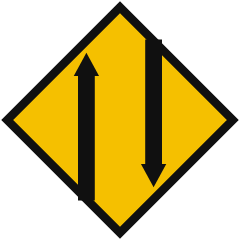
7. Which action becomes clearly more risky beyond this sign?
Show answer
Answer A: Using the left side of the roadway to overtake
With vehicles coming the other way on the same pavement, overtaking on the left needs enough clear road to pull out, pass and return, which is often not available.
-
8. A city transit bus at a stop ahead of you switches on its left signal. What should you do?
Show answer
Answer D: Slow and let the bus pull back into traffic
A bus needs a long gap to rejoin traffic, and yielding to a signaling transit bus keeps the whole line of traffic moving safely.
-
9. You stop behind another vehicle at a traffic light. How much space should you leave?
Show answer
Answer D: Enough to see where its rear tires touch the pavement
Seeing the rear tires on the road leaves room to steer around the vehicle if it stalls, and gives a cushion if you are struck from behind.
-
10. A fire truck with lights and siren has just passed you and is heading down the same road. How closely may you follow it?
Show answer
Answer B: Well back, because following a responding emergency vehicle closely is illegal
Following a responding emergency vehicle closely is prohibited; the exact minimum distance is set by each state, so stay far enough back to keep the scene and other responders clear.
-
11. Under Louisiana's implied consent rules, how long is a first refusal to submit to a chemical test?
Show answer
Answer B: 365 days
A first refusal costs the driver 365 days of driving privileges in Louisiana, and a second or later refusal costs 730 days.
-
12. What is the best way to handle the radio, the music player and the climate controls on a trip?
Show answer
Answer B: Set them before you start driving and let a passenger handle changes
Fiddling with controls takes eyes and hands off the driving task. Setting them before you move and letting a passenger make later changes removes the distraction entirely.
-
13. Where must a Louisiana driver stop when a railroad crossing requires a stop?
Show answer
Answer B: Within 50 feet of the nearest rail but no closer than 15 feet
Louisiana sets the stopping window at no more than 50 feet and no less than 15 feet from the nearest rail, and forbids changing gears on the tracks.
-
14. What passenger limit applies to a Louisiana intermediate licensee between 6:00 p.m. and 5:00 a.m.?
Show answer
Answer A: No more than one passenger under 21 who is not an immediate family member
In those evening and early morning hours the intermediate driver may carry only one passenger under 21 who is not part of the immediate family.
-
15. A Louisiana owner's compulsory insurance has been lapsed for 45 days. What reinstatement fee applies?
Show answer
Answer C: 250 dollars
Louisiana charges 100 dollars for a lapse of 1 to 30 days, 250 dollars for a lapse of 31 to 90 days, and 500 dollars once the lapse exceeds 90 days.
-
16. What is the general maximum speed limit for a vehicle in Louisiana, and where is a higher limit posted?
Show answer
Answer D: 70 mph generally, with 75 mph on portions of Interstate 49
The Louisiana driver's guide gives 70 mph as the maximum for any vehicle, with portions of Interstate 49 posted at 75 mph.
-
17. You are slowing to turn right at an intersection and a bicyclist is riding beside your right side in a bike lane. What should you do?
Show answer
Answer D: Let the bicyclist go through the intersection before you begin the turn
Turning across the path of a bicyclist who is going straight causes the classic right-hook crash. The rider continuing straight has the right-of-way over your turn.
-
18. What do white lane lines painted between travel lanes indicate?
Show answer
Answer A: Traffic in the adjacent lane moves in the same direction as you
White markings separate lanes carrying traffic in the same direction and mark the right edge of the roadway.
-
19. A Louisiana driver over 21 submits to a test and registers 0.15 percent. What administrative suspension follows?
Show answer
Answer C: Two years, or 730 days
Results of 0.08 to 0.149 percent bring a 180 day suspension, while a result of 0.15 percent or higher brings a two year suspension.
-
20. You have started to pass and you see the no-passing zone beginning ahead. What should you do?
Show answer
Answer D: Ease off, drop back and return to your own lane
A pass must be completed before the no-passing zone starts. If it will not fit, abandon it and slot back in behind.
-
21. How long must a Louisiana driver keep an SR-22 filing on record after a conviction that requires proof of future financial responsibility?
Show answer
Answer A: Three years from the date of conviction
Louisiana requires the SR-22 certificate to be maintained for three years from the conviction date, with a cash or security deposit of 30,000 dollars as the alternative.
-
22. Which exception does Louisiana allow to its restrictions on automated speed enforcement?
Show answer
Answer D: Enforcement in a highway construction zone where workers are actively present
Louisiana permits automated speed enforcement in highway construction zones where the department or its contractors are actively working and construction workers are present, an exception that does not extend to local authorities.
-
23. You are in the open lane where another lane is merging into yours. What is your part in the merge?
Show answer
Answer A: Keep a steady speed and leave a gap for one vehicle to come in
A merge works when each driver in the through lane lets one vehicle in, which keeps both lines moving instead of stopping them both.
-
24. On a long uphill grade a second lane opens on the right and a sign directs slower traffic into it. You are towing a trailer and holding up a line of vehicles. What should you do?
Show answer
Answer A: Move into the right-hand lane and let the faster traffic use the left lane
A climbing lane exists so that slow vehicles can be passed safely, and the slower vehicle is the one that belongs in it.
-
25. In which crash must the police always be notified?
Show answer
Answer D: Any crash in which somebody has been injured or killed, whatever the damage
Injury or death always makes a crash reportable, whatever the amount of vehicle damage or the opinions of the drivers.
-
26. May you use a relative's accessible parking placard to park in a marked accessible space?
Show answer
Answer D: No, only when the placard holder is being transported in the vehicle
A placard belongs to the person, not to the car, so it is valid only when that person is being transported; using it otherwise takes a space from someone who needs it.
-
27. Some crosswalks are marked with two transverse lines and others with a row of wide bars laid along the direction of travel. Why is the second pattern used?
Show answer
Answer B: It is far easier for an approaching driver to see
Longitudinal bar patterns are used where extra visibility is wanted, such as an uncontrolled crossing or one near a school, because they show up much better from a car.
-
28. You are driving at night on an unlit road using low beams. How should you choose your speed?
Show answer
Answer C: So you could stop within the distance your headlights light up
Driving faster than you can stop within the lit area is called overdriving your headlights. Anything beyond the beam is invisible until it is too late to react.
-
29. A driver hunting for an on-ramp meets this sign at the mouth of the pavement ahead. What is the correct action?

Show answer
Answer C: Keep out of that roadway and look for the proper approach elsewhere
The restriction is absolute and does not depend on how much traffic is present, so the driver has to reach the highway by an approach built for entering vehicles.
-
30. Another driver has pulled out to pass you. What should you do?
Show answer
Answer A: Stay in your lane, keep your speed steady or ease off, and let the pass finish
Accelerating while being passed forces the other driver to stay in the opposing lane longer, so the safe response is to hold or slightly reduce speed and stay right.
-
31. Under Louisiana's child passenger restraint law, how must a child of 18 months be transported?
Show answer
Answer A: In a rear-facing federally approved car seat
Louisiana requires rear-facing seating from birth until at least age 2, then forward-facing seats from 2 to 4 and boosters from 4 to 9.
-
32. What does electronic stability control do that ordinary brakes cannot?
Show answer
Answer C: It brakes single wheels to bring the vehicle back on your intended path
The system compares where you have steered with where the vehicle is actually going, then brakes individual wheels to pull it back into line.
-
33. You are circulating in a roundabout and a vehicle is waiting to enter ahead of you. What should you do?
Show answer
Answer D: Keep going, because circulating traffic does not stop for entering vehicles
Stopping in the circle to be polite surprises the drivers behind you and defeats the design; entering traffic is the side that waits.
-
34. What is worth carrying in the vehicle during a winter trip?
Show answer
Answer A: A blanket, a flashlight, a scraper and a small shovel
A winter kit keeps you warm and visible if you are stopped for hours, and lets you clear glass and dig the wheels out. Hot water can crack cold glass.
-
35. A hands free phone conversation is which kind of distraction?
Show answer
Answer C: Cognitive, because your mind leaves the road
Hands free equipment removes the manual and visual parts of a call but not the mental load, and it is the mental load that makes a driver miss hazards.
-
36. Another driver takes a right of way that was legally yours. What should you do?
Show answer
Answer A: Give way to the other driver and avoid the crash, whatever the law says
Right of way is something you give, not something you take, and being in the right is no protection in a collision.
-
37. What is a driver being warned about here?
Show answer
Answer B: The pavement ahead carries vehicles traveling in the opposite direction
Beyond this point vehicles come the other way on the same pavement, which commonly happens where a one-way section or a separated stretch comes to an end.
-
38. May you park at the curb immediately next to a railroad crossing?
Show answer
Answer A: No, you must leave the crossing and its approach clear
Parking beside a crossing hides the tracks and the signals from approaching drivers and leaves no room for a vehicle that has to clear the rails.
-
39. In which case does Louisiana's bar on recovery by an uninsured motorist not apply?
Show answer
Answer A: When the at fault driver fled the scene of the accident
The bar lifts where the at fault driver fled the scene, intentionally caused the crash, was committing a felony or was convicted of driving while intoxicated, and where the other vehicle was lawfully parked.
-
40. Besides school signing, which warning signs may also use a fluorescent yellow-green background?
Show answer
Answer C: Pedestrian and bicycle warning signs
Pedestrian crossing, bicycle and playground warning signs may use either the standard yellow or the fluorescent yellow-green background, which draws extra attention where people outside vehicles are present.