
Louisiana OMV Permit Practice Test 10
- Questions40
- Correct to pass32
- Passing score80%
- Minimum age15 years
-
1. You have a green light at a school crossing, but the crossing guard steps out and holds up a stop sign toward you. What must you do?
Show answer
Answer A: Stop, because the crossing guard controls this crossing and outranks the signal
Directions from a crossing guard or a police officer take priority over signals and signs.
-
2. Which part of the space around your vehicle can you control best?
Show answer
Answer A: The space ahead of you
You choose your own following distance, so the gap in front is the space you truly control and the one that gives you time to react.
-
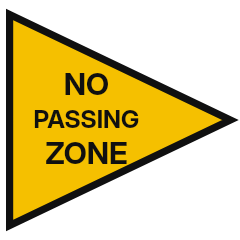
3. A driver is thinking about overtaking a slower vehicle and sees this sign a short distance ahead. What does it mean for that pass?
Show answer
Answer B: The pass must be finished before the restricted section begins
The sign marks the start of a section where passing is prohibited, so a driver may not be on the left side of the road beyond it; any pass has to be completed before that point or not started at all.
-
4. A small plaque mounted under this sign shows a numeral such as 2 or 3. What does that numeral report?

Show answer
Answer A: How many sets of tracks the crossing carries
The plaque states the number of tracks at that location, which is a warning that a second train may be running on another track behind the first.
-
5. At a railroad crossing with no gates and no flashing lights, the crossbuck is normally combined with which sign?
Show answer
Answer C: A yield sign, or a stop sign where an engineering study calls for one
At a passive crossing the crossbuck forms an assembly with a yield sign, or with a stop sign when an engineering study or engineering judgment supports it, so the driver knows who must give way to the train.
-
6. At an intersection the signal flashes red toward you and flashes yellow toward the cross street. Who must yield?
Show answer
Answer D: You must, because the flashing red faces your road
A flashing red means stop and yield like a stop sign, while a flashing yellow lets the other road proceed with caution.
-
7. You arrive at an intersection where the traffic signals are completely dark after a power failure. What should you do?
Show answer
Answer A: Treat the intersection as an all-way stop and take turns
When a signal is dark or out of order, drivers on every approach must stop and proceed in turn, exactly as at a four-way stop.
-
8. How do worn tires and worn brakes affect your ability to stop?
Show answer
Answer C: They lengthen the stopping distance, especially on a wet road
Worn tread cannot clear water and worn brakes cannot produce full force, so both stretch the distance needed to stop.
-
9. Your vehicle has antilock brakes. What should you never do in an emergency stop?
Show answer
Answer A: Pump the pedal up and down
The system already releases and reapplies the brakes many times a second. Pumping the pedal interrupts it and makes the stop longer.
-
10. Why should you stay out of an intersection you cannot clear, even on a green light?
Show answer
Answer B: Because you would block cross traffic when their signal turns green
A vehicle stranded in the intersection blocks the cross street when its light turns green, which stalls the whole junction and traps emergency vehicles.
-
11. A snow squall cuts visibility to almost nothing while you are on a highway. What must you not do?
Show answer
Answer D: Stop in a travel lane and wait for the squall to blow through
A vehicle stopped in a lane in a whiteout is invisible until someone hits it. Slow gradually and keep moving until you can leave the roadway completely.
-
12. The driver ahead of you is straddling the lane line and is not signaling. How should you respond?
Show answer
Answer B: Stay back until you can see which lane that driver will take
A vehicle astride the line could move either way, so the only safe place is behind it where both possibilities are still covered.
-
13. An angry driver is following you closely and gesturing at you. What is the safe response?
Show answer
Answer B: Drive to a police station or to a busy public place and call for help
Never stop to confront an aggressive driver and never lead one home; go somewhere public and get the police involved.
-
14. What counts as a complete stop at a stop sign?
Show answer
Answer C: The wheels stop turning before the stop line
A legal stop means the vehicle is no longer moving, made at the stop line or before entering the crosswalk or intersection.
-
15. The traffic signal is green, but the crossing lights on the tracks inside the intersection begin to flash. What must you do?
Show answer
Answer C: Stop clear of the tracks and wait, even though the signal is green
Active crossing warning devices outrank the green indication, so you stop short of the rails and wait until the warning stops.
-
16. You enter a corner faster than the turn can be taken. What is the most likely result?
Show answer
Answer A: The vehicle runs wide and may cross into another lane
Excess speed uses up the available grip, so the vehicle follows a wider arc than intended and drifts out of its lane.
-
17. You are hosting a party and a guest who has been drinking wants to drive home. What should you do?
Show answer
Answer D: Stop serving and arrange a ride or a bed
Only time removes alcohol, so a host who wants to prevent a crash has to remove the driving, not try to speed up sobering that cannot be sped up.
-
18. What marking identifies a Louisiana credential as REAL ID compliant?
Show answer
Answer D: A white star with a gold outline near the top of the card
Louisiana prints a white star outlined in gold on the upper portion of a REAL ID compliant license or identification card; a non compliant card instead reads Not for Federal Identification.
-
19. Which headlight setting should you use in dense fog?
Show answer
Answer B: Low beams
High beams reflect off the water droplets in fog and bounce glare back at you, while low beams aim downward and light the road without that mirror effect.
-
20. As a center two-way left-turn lane reaches an intersection, the markings change into a single left-turn lane. What does that mean for you?
Show answer
Answer D: From that point it serves one direction only, so use it just to turn left
Where the shared lane becomes a marked turn bay it belongs to one direction of travel, and only vehicles making that left turn may occupy it.
-
21. A steady green downward arrow is displayed above the lane you are in. What does it tell you?
Show answer
Answer A: You may drive in that lane
A green downward arrow means the lane beneath it is open for travel in your direction.
-
22. The red oil pressure warning light comes on while you are driving. What should you do?
Show answer
Answer C: Pull over safely as soon as possible and shut off the engine
Loss of oil pressure means the engine is no longer being lubricated and can be destroyed within minutes. Stop, shut down and check before restarting.
-
23. A yield sign is posted where an entrance ramp meets the highway. What must you do?
Show answer
Answer C: Give way to the traffic already on the highway and merge into a gap
The yield sign confirms that the merging driver is the one who must fit into the traffic stream rather than the other way round.
-
24. A sign with a black legend on a fluorescent pink background is used for
Show answer
Answer A: traffic incident management
Fluorescent pink is set aside for signing that manages traffic around a crash, a spill or another unplanned incident, so it stands apart from routine work zone orange.
-
25. What is the correct technique for backing a vehicle straight?
Show answer
Answer B: Check behind the vehicle before getting in, then turn and look through the rear window while backing slowly
Mirrors and cameras leave gaps close to the vehicle, so walk behind it first, then turn in your seat for a direct view and keep the speed low enough to stop instantly.
-
26. Your vehicle is burning at the roadside. How far away should everyone keep?
Show answer
Answer D: At least a hundred feet away from the vehicle and upwind, out of the drifting smoke
Burning vehicles give off toxic smoke and parts such as tires and struts can burst, so keep a long distance and stay upwind.
-
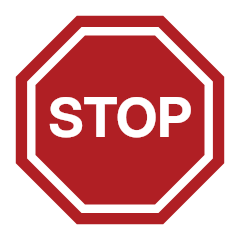
27. A driver slows to walking pace at this sign, never stops rolling and eases into the intersection. How is that treated?
Show answer
Answer B: It is a violation, because the vehicle never came to a complete halt
What is required is a full halt with the wheels no longer turning, so slowing down, however carefully, does not satisfy it.
-
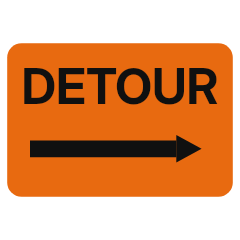
28. Once a driver has joined the route this sign begins, how is the rest of the way marked?
Show answer
Answer B: By further markers of the same kind at each turn, until the original road is rejoined
The alternate route is signed continuously, with a marker at every turn, so a driver with no local knowledge can follow it back to the original road.
-
29. About how far behind a tractor-trailer does the driver's rear blind spot reach?
Show answer
Answer C: Around 30 feet
The area behind a large truck is hidden for roughly 30 feet, so a driver tucked in there cannot be seen at all.
-
30. You are passing a tractor-trailer on a wet freeway and its wheels throw heavy spray. What is the best technique?
Show answer
Answer B: Increase your wipers and pass steadily without hesitating
Spray blinds you for as long as you stay beside the truck, so prepare the wipers first and then spend as little time in the spray as possible.
-
31. Who does Louisiana's open container law reach?
Show answer
Answer C: Both the operator and any passenger in the passenger area
The prohibition on possessing an open container or consuming alcohol in the passenger area applies to the operator and to passengers alike while the vehicle is on a public highway.
-
32. What habit prevents the hood from flying up while you are driving?
Show answer
Answer D: Press the hood down at the front and check that the latch has caught
Most hoods fly up because they were left on the safety catch, so check that the main latch is fully closed after any work under the hood.
-
33. A child in the back seat unfastens a seat belt while you are on the freeway. What should you do?
Show answer
Answer A: Pull off safely and refasten the belt
Turning or reaching back takes your eyes and hands off a high speed task, so leave the freeway or use the shoulder only if there is no exit, then fix the belt.
-
34. May you stop in the striped triangle that separates an exit ramp from the freeway lanes?
Show answer
Answer A: No, it is not a lane and stopping there is dangerous
The striped gore area is not a travel lane or a shoulder, and a vehicle stopped there sits directly in the path of drivers correcting a late exit.
-
35. How many items must the Louisiana knowledge test for Group D and Group E applicants contain at a minimum?
Show answer
Answer A: At least 32 items
Louisiana law sets a statutory floor: the knowledge test for Group D and Group E applicants must contain at least 32 items, of which 80 percent must be answered correctly.
-
36. The word SCHOOL is painted in large letters across the roadway. What is it doing?
Show answer
Answer D: Backing up the signs marking a school zone
Word markings on the pavement reinforce a message that is already signed, and a driver looking at the road ahead cannot miss them.
-
37. You are on a city street with two lanes in your direction, cars parked along the curb and driveways every few yards. Which lane is usually safer?
Show answer
Answer B: The lane farther from the curb, away from opening doors and vehicles pulling out
Most of the hazards on such a street come from the curb side, so the inside lane gives you more space and more time to react.
-
38. Two roads come together at a shallow angle under a MERGE sign, with no yield line on either one. What is expected of you?
Show answer
Answer D: Adjust your speed and position so you blend smoothly into the other traffic
A merge means neither road ends at a stop; drivers adjust speed and position so that the two streams fit together without stopping.
-
39. How often should the spare tire be checked?
Show answer
Answer C: Regularly, because a spare loses pressure while it sits unused
Spares lose air slowly over months, and a flat spare is useless at the moment you need it.
-
40. On a narrow residential street, why does parking tight against the curb matter so much?
Show answer
Answer C: Because fire trucks and ambulances need the width to get through
Cars parked even a foot out from the curb on both sides can narrow a street until a fire truck or ambulance cannot pass.