
Louisiana OMV Motorcycle Practice Test 37
- Questions25
- Correct to pass20
- Passing score80%
- Minimum ageSee note
-
1. Why should gloves and jacket sleeves overlap?
Show answer
Answer A: So no gap of bare skin is left at the wrist in a slide or the cold
The wrist is easy to leave exposed, and a gap there lets in cold air and takes the full force of a slide, so gauntlets or elastic cuffs should close the gap.
-
2. Well before an intersection, an overhead sign shows a diagram of the lanes with an arrow above each one. What is its purpose?
Show answer
Answer C: To let drivers pick the correct lane in good time
Advance intersection lane control signs display the lane assignment far enough back that drivers can move over calmly instead of at the last moment.
-
3. You come upon a person riding a horse on the roadway ahead of you. What is the correct way to pass?
Show answer
Answer A: Slow down, give plenty of room and do not use the horn
Horses startle easily, and a frightened horse can throw its rider into your path. Pass slowly and wide, and avoid any sudden noise.
-
4. A yellow diamond showing a bicycle is posted on a rural road. What should a driver expect?
Show answer
Answer A: Bicyclists crossing or riding along the roadway there
The bicycle warning sign is used where a bikeway crosses the road or where riders are likely to be in the traffic lanes, so drivers should look carefully and pass wide.
-
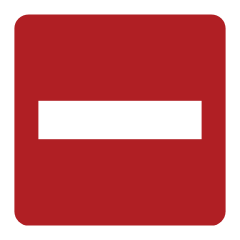
5. At which location is this sign normally installed?
Show answer
Answer D: Facing traffic that could turn into a one-way roadway or ramp against the flow
It is posted where a driver could otherwise enter a ramp or a one-way roadway from the wrong end, so it faces exactly the traffic that has to be kept out.
-
6. You are making a U-turn at a signal on a green left arrow. Who must you still watch for?
Show answer
Answer D: People in the crosswalk you will cross as you come around
Even a protected arrow does not clear the crosswalk, and a U-turn sweeps across a crosswalk that pedestrians may already be using.
-
7. At 45 mph you look at a navigation screen for four seconds. Roughly how far do you travel unseeing?
Show answer
Answer D: About 260 feet
At 45 mph you cover roughly 66 feet a second, so four seconds on a screen is around 260 feet of road that you never looked at.
-
8. In a normal signal cycle, what comes after a steady red indication?
Show answer
Answer A: A green indication that starts the next movement
Yellow is a warning that a movement is ending, so it never precedes a green; a red is followed by a green or a green arrow.
-
9. When should you move into the lane you need for a turn?
Show answer
Answer D: Well before the intersection, as soon as you know your route
Getting into the correct lane early lets other drivers read your intentions and keeps you from making a sudden lane change at the corner.
-
10. Your vehicle stalls on railroad tracks and you see a train approaching. What should you do?
Show answer
Answer D: Get everyone out and run toward the train at an angle away from the tracks
Leave the vehicle at once. Running toward the oncoming train and away from the tracks keeps you clear of the wreckage, which is thrown forward in the direction the train is moving.
-
11. You are turning left at an intersection and an oncoming bicyclist is approaching in the bike lane. What must you do?
Show answer
Answer B: Yield and complete the turn only after the bicyclist has passed
A bicycle in the roadway has the same right of way as a vehicle, so a left-turning driver must yield to an oncoming rider just as to an oncoming car.
-
12. What does a light drag of the rear brake do during a slow, tight turn?
Show answer
Answer C: It steadies the motorcycle and smooths out the power reaching the rear wheel
Working the rear brake against a slipping clutch takes the jerkiness out of the drivetrain and holds the machine steady through the turn.
-
13. What does a shaft final drive need checked before a ride?
Show answer
Answer D: The fluid level in the final drive housing, and any sign of leaks
A shaft drive runs in its own oil bath, so the pre-ride check is the fluid level and any leak around the housing seals rather than tension or slack.
-
14. What should you do with the key and your belongings when you leave the vehicle in a public lot?
Show answer
Answer D: Take the key with you, lock up and put valuables out of sight
Most vehicle thefts are opportunistic: a key left behind or a bag in plain view is the invitation.
-
15. What should a rider look for in rain gear?
Show answer
Answer A: A riding rain suit that fits close and will not balloon or tear at speed
Rain gear designed for riding stays sealed and stays put in the airstream, while loose garments can flap, tear or interfere with the controls.
-
16. A sign on a divided highway reads Keep Right Except to Pass. What does it require of you?
Show answer
Answer A: Use the left lane only to overtake, then return to a lane on the right
The left lane on such a highway is reserved for overtaking, so a driver who has finished a pass must move back to the right.
-
17. May you park across the entrance to a fire station?
Show answer
Answer D: No, an emergency exit must never be blocked
Emergency vehicles must be able to leave the moment a call comes in, so their entrances and exits are kept clear at all hours.
-
18. Two solid white lines are painted between your lane and the lane beside it. What do they mean?
Show answer
Answer D: Crossing from one lane to the other is prohibited
Double solid white lines separate lanes of traffic going the same way and may not be crossed.
-
19. What does a broken line indicate, whatever color it is painted?
Show answer
Answer C: That crossing it is permitted
A broken line always describes a permissive condition, and the color then tells the driver whether the traffic beyond it runs the same way or the opposite way.
-
20. Besides school signing, which warning signs may also use a fluorescent yellow-green background?
Show answer
Answer C: Pedestrian and bicycle warning signs
Pedestrian crossing, bicycle and playground warning signs may use either the standard yellow or the fluorescent yellow-green background, which draws extra attention where people outside vehicles are present.
-
21. Oil is visible running down the front fork tubes. What does that mean?
Show answer
Answer C: A fork seal has failed and the suspension needs repair
Fork oil escaping past a seal means the front suspension is losing its damping, and the oil can also reach the front brake and ruin its grip.
-
22. A bicyclist is riding around a single-lane roundabout in the middle of the lane as you wait to enter. What is your duty?
Show answer
Answer C: Yield to the bicyclist just as you would to a car
A bicyclist using the roundabout is traffic like any other vehicle and has the same claim to the circulating lane.
-
23. How should the mirrors be set before setting off?
Show answer
Answer B: So that each mirror shows the lane behind and part of the lane beside
Mirrors aimed too far inward show mostly the rider, wasting the view that is meant to cover the traffic behind and to the side.
-
24. How should your speed behave while you move from one lane into the next?
Show answer
Answer C: Keep it steady or adjust it smoothly to match the traffic in the new lane
A lane change works best as a smooth movement at the speed of the lane you are joining, since sudden braking or acceleration surprises the drivers around you.
-
25. In which situation should you increase your usual following distance?
Show answer
Answer B: On wet roads, at night, in fog, when towing a trailer, or when following a motorcycle
Reduced traction, reduced visibility, a heavier load and a vehicle that can stop faster than yours all require extra space to keep the same margin of safety.