
Louisiana OMV Motorcycle Practice Test 34
- Questions25
- Correct to pass20
- Passing score80%
- Minimum ageSee note
-
1. On a two-lane road with a broken yellow center line, may you cross it to turn into a driveway on the left?
Show answer
Answer C: Yes, when it is safe and the oncoming lane is clear
A broken center line may be crossed for a pass or for a left turn into a road or a driveway, once the oncoming lane is clear.
-
2. Lights set into the pavement along both edges of a crosswalk start to flash yellow as you approach. What do they tell you?
Show answer
Answer D: Someone is crossing and has to be given way
In-roadway warning lights flash only when a pedestrian activates the crossing, so a flashing pattern means somebody is in or entering the crosswalk.
-
3. A mixed drink is made with two shots of spirits. How much alcohol is that?
Show answer
Answer C: About two standard drinks
A standard drink is a fixed amount of pure alcohol, so a glass poured with two measures counts as two drinks however it is served.
-
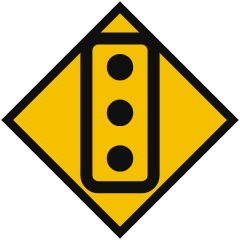
4. A driver passes this sign and the signal beyond it is already showing green. What is the safest response?
Show answer
Answer C: Ease off the accelerator and be ready to stop, because an indication that has been showing for a while is about to change
A signal that has been displaying the same indication for some time is close to changing, so arriving at a controlled speed with the brake covered is safer than accelerating to beat it.
-
5. Where is a U-turn most clearly unsafe and generally prohibited?
Show answer
Answer D: On a curve or near a hill crest, where other drivers cannot see you
U-turns are barred where approaching drivers cannot see you in time, such as on a curve or near the top of a hill.
-
6. What is the maximum penalty under Louisiana's general traffic penalty section for a first offense?
Show answer
Answer D: A fine of not more than 175 dollars, or up to 30 days in jail, or both
Louisiana's general traffic penalty for a first offense is a fine of up to 175 dollars or imprisonment for up to 30 days, or both.
-
7. How much should you normally reduce your speed on a road covered with packed snow compared with dry conditions?
Show answer
Answer C: By about half
Packed snow roughly doubles the distance needed to stop, so a common guideline is to cut speed by about half. On ice, slow to a crawl.
-
8. A bag strapped to the back of your motorcycle works loose and starts to shift as you ride. What should you do?
Show answer
Answer C: Slow smoothly, pull off the road, and secure the load before riding on
A load that moves changes the balance of the motorcycle and can foul a wheel or the chain, so stop as soon as you safely can and fasten it properly.
-
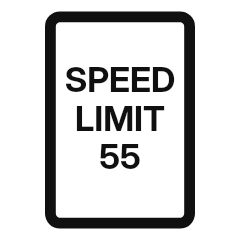
9. On a clear day with light traffic, a driver stays far below the maximum this sign sets. What can that cause?
Show answer
Answer B: Obstruction of the normal flow of traffic, which is prohibited in itself
Driving so slowly that other traffic is impeded is an offense in its own right when nothing about safety, weather or the road calls for it.
-
10. What is a marked loading zone for?
Show answer
Answer A: Loading and unloading only, not for general parking
A loading zone is reserved for actively loading or unloading goods or passengers; leaving a vehicle there for other reasons is a parking violation.
-
11. What lets a Louisiana applicant skip the motorcycle skills test?
Show answer
Answer D: Successfully completing the Motorcycle Safety, Awareness, and Operator Training Program
Louisiana waives the operator skill test for an applicant who has completed the state Motorcycle Safety, Awareness, and Operator Training Program.
-
12. Traffic has built up behind you while you wait for a gap to turn left. How should that affect your decision?
Show answer
Answer C: It should not change it; wait for a gap that is genuinely safe
Pressure from behind does not make a small gap bigger, and rushing a left turn across traffic is a common cause of serious crashes.
-
13. What is the safest way to pass a bicyclist on a road with two lanes going your way?
Show answer
Answer D: Change lanes completely, as you would for a car
A bicycle is entitled to the room a vehicle needs, and moving into the next lane gives the rider space to swerve around a drain or a pothole.
-
14. What has to be done with the helmet chin strap on every ride?
Show answer
Answer B: Fastened snugly, because an unfastened helmet comes off in a crash
A helmet only protects while it stays on the head, and an unfastened or loose strap lets it leave the head in the first moments of a crash.
-
15. How does the distance needed to stop change when a rider doubles speed?
Show answer
Answer D: It grows to roughly four times the original distance
Braking distance rises with the square of speed, so twice the speed needs roughly four times the distance in which to stop.
-
16. How should a group decide how often to stop for fuel?
Show answer
Answer A: By the range of the machine with the smallest fuel tank
Planning around the smallest tank keeps the group from splitting up when one rider has to leave the route to look for fuel.
-
17. Your group is turning left across oncoming traffic. What should you do?
Show answer
Answer D: Wait until you personally have a large enough gap to turn
Each rider needs a gap of their own, and turning on the strength of the rider ahead means turning into traffic you have not actually judged.
-
18. Traffic safety experts describe three kinds of driver distraction. Which set is correct?
Show answer
Answer A: Visual, manual and cognitive
Distraction takes the eyes off the road, the hands off the controls or the mind off driving, and many activities do more than one of those at once.
-
19. How should a rider use a motorcycle fitted with antilock brakes in an emergency stop?
Show answer
Answer D: Apply firm, steady pressure to both brakes and keep it there
An antilock system releases and reapplies pressure far faster than a rider can, but only while the rider keeps holding the brakes on.
-
20. You turn left onto a road that has a center two-way left-turn lane. In which lane should you be traveling once the turn is finished?
Show answer
Answer D: The first through lane to the right of the center turn lane
The shared center lane is only for turning movements, so even where a state lets you pause in it to merge you must end up in the first ordinary travel lane beside it.
-
21. You are riding directly into a low sun that is glaring off your face shield. What should you do?
Show answer
Answer A: Slow down and assume that drivers ahead of you cannot see you either
Glare cuts what everyone can see, so lower speed buys reaction time, and a driver blinded by the same sun is even less likely to notice a motorcycle.
-
22. You are crossing a divided highway with a wide median. How should you treat the two roadways?
Show answer
Answer D: As two intersections, waiting in the median only when your vehicle fits
Each roadway of a divided highway is a separate intersection, and you should wait in the median only if it is long enough to hold your vehicle clear of both roadways.
-
23. What should a rider do if the front wheel locks during braking?
Show answer
Answer A: Release the front brake immediately, then reapply it firmly
A locked front wheel cannot steer or hold the motorcycle up, so the brake must be released to let the wheel roll again and then reapplied smoothly.
-
24. An angry driver is following you closely and gesturing at you. What is the safe response?
Show answer
Answer B: Drive to a police station or to a busy public place and call for help
Never stop to confront an aggressive driver and never lead one home; go somewhere public and get the police involved.
-
25. The front tire suddenly loses air while you are riding. What should you do?
Show answer
Answer D: Hold the bars firmly, ease off the throttle and slow using the rear brake
A deflating front tire makes the steering feel heavy, so the rider keeps a straight line, avoids the affected wheel when braking and eases off the road.