
Louisiana OMV Motorcycle Practice Test 10
- Questions25
- Correct to pass20
- Passing score80%
- Minimum ageSee note
-
1. A city transit bus at a stop ahead of you switches on its left signal. What should you do?
Show answer
Answer D: Slow and let the bus pull back into traffic
A bus needs a long gap to rejoin traffic, and yielding to a signaling transit bus keeps the whole line of traffic moving safely.
-
2. Why are ordinary denim jeans a poor choice for riding?
Show answer
Answer C: They wear through in a slide, giving little abrasion protection
Light denim abrades away in a fraction of a second on pavement, while leather or purpose made textile gear stays intact long enough to protect the skin underneath.
-
3. A traffic light ahead of the group turns yellow as the leader approaches it. What should the leader do?
Show answer
Answer C: Stop normally and let the group be split by the signal
Keeping the group together never outranks obeying the signal, and the riders left behind simply catch up at the next stop.
-
4. Does wearing properly fitted earplugs stop a rider from hearing important sounds?
Show answer
Answer C: No, they lower overall noise while horns and speech still register
Earplugs reduce the wind roar that masks everything else, so riders wearing them often hear traffic more clearly, not less, while their hearing is protected.
-
5. Your motorcycle starts to wander while you ride over rain grooves or a bridge grating. What should you do?
Show answer
Answer A: Relax, hold a steady speed and ride straight across
The wandering feeling on grooved surfaces and gratings is unsettling but generally not hazardous, while zigzagging to fight it is far more dangerous.
-
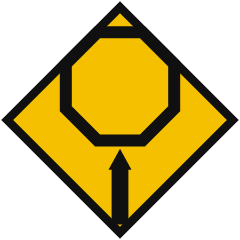
6. What is the driver expected to do after passing this sign?
Show answer
Answer A: Begin slowing so that a complete stop can be made at the intersection ahead
It is used where the control at the intersection stays hidden until late, so braking should begin here rather than at the stop line.
-
7. A signal beside a fire station stays dark until apparatus is about to leave, when it shows yellow and then red. What must a driver do?
Show answer
Answer B: Stop on the red and wait until the signal goes dark again
An emergency vehicle signal is a real traffic signal, so its red indication must be obeyed while the apparatus pulls out into the street.
-
8. From which lane should a permitted U-turn be started?
Show answer
Answer A: The lane nearest the center line, the same one used for a left turn
A U-turn is begun from the far left lane for your direction, the same position used for a left turn, so you do not cut across traffic beside you.
-
9. Why is a shoulder check especially important on a road with motorcycles and bicycles?
Show answer
Answer D: A narrow vehicle can disappear completely in the blind spot
A motorcycle or a bicycle is small enough to be hidden entirely by a door pillar or by the blind spot the mirrors do not cover.
-
10. In which situation does Louisiana law forbid a driver from refusing a chemical test altogether?
Show answer
Answer D: Whenever a fatality has occurred or a person has sustained serious bodily injury
Louisiana removes the option of refusal where the incident caused a death or serious bodily injury, and also where the driver has already refused on two previous and separate occasions.
-
11. A row of solid white triangles points toward you across your lane. What does it mark?
Show answer
Answer A: The place to yield to traffic or people ahead
A yield line of triangles shows drivers exactly where to give way, and it is used at roundabouts and at midblock crosswalks.
-
12. The vehicle you have borrowed is larger and heavier than your own. How should you drive it?
Show answer
Answer B: Allow more room for stopping and for turns until you are used to it
Extra weight and length mean longer stopping distances and wider turns, so give yourself more room until you are used to it.
-
13. Partway through a ride, a control starts to feel different from the way it normally feels. What is the right response?
Show answer
Answer B: Stop somewhere safe and find out what has changed before riding further
A change in feel is usually the first warning of a failing cable, a leaking brake or a loose fastener, and it is far cheaper to check at the roadside than to discover in traffic.
-
14. A separate right-turn lane leads onto the cross street and carries a yield sign. What does it require?
Show answer
Answer D: Slowing and giving way to traffic and people, stopping if needed
A yield requires you to slow, give way to traffic in the lane you are joining and to pedestrians, and stop only if that is what safety demands.
-
15. Besides impact protection, how does a light colored helmet help the rider?
Show answer
Answer A: It sits above surrounding traffic, so drivers pick it out sooner
A light or high visibility helmet sits above the traffic around the rider and is often the first part of a motorcycle a driver notices.
-
16. What fine does Louisiana law set for a traffic violation committed on a stretch of road designated as a highway safety corridor?
Show answer
Answer A: Not less than 750 dollars nor more than 1,000 dollars, or up to 30 days
A violation committed on a designated highway safety corridor carries a fine of 750 to 1,000 dollars and may bring imprisonment of up to 30 days.
-
17. Where should a passenger sit on the motorcycle?
Show answer
Answer A: As far forward as possible without crowding the operator
Sitting well forward keeps the passenger weight close to the center of the motorcycle, which helps it handle closer to normal.
-
18. You are turning left out of a driveway onto a busy two-way street. What must you do?
Show answer
Answer D: Wait for a gap in both directions before you start to move
The turn crosses one direction of traffic and joins the other, so you need a gap in both before leaving the driveway rather than stopping across a lane.
-
19. An ambulance with lights and siren is coming toward you on an undivided two-lane road. What must you do?
Show answer
Answer A: Pull to the right edge and stop until it passes
On an undivided road, drivers in both directions clear the way, pulling to the right edge and stopping.
-
20. How does becoming chilled affect a rider before any shivering is obvious?
Show answer
Answer D: It slows reactions and clouds judgment while the rider still feels fine
Cooling degrades reaction time and decision making before the rider notices it, so dress for the coldest part of the ride and stop to warm up rather than pressing on.
-
21. Why should pant legs be secured and bootlaces tucked away?
Show answer
Answer A: Loose fabric and laces can tangle in the chain, the controls or a wheel
Anything hanging near the moving parts of a motorcycle can be caught and pulled in, which can trap a foot or lock the rear wheel.
-
22. An oncoming driver flashes their headlights while you are waiting to turn left. What should you do?
Show answer
Answer D: Judge the situation yourself, since the flash may mean something else
A flash is not a legal signal and may mean many things, so the decision to turn stays yours and must be based on what you can see.
-
23. What kind of sole and heel suit motorcycle boots?
Show answer
Answer A: A hard, slip resistant sole with a low heel that will not catch
Boots have to grip the pavement when you put a foot down and grip the footrests while you ride, and a tall heel can catch on the ground or on the machine.
-
24. You and an opposing driver reach a four-way stop at the same time and both of you are turning right. What should happen?
Show answer
Answer C: Both may turn at the same time into their own lanes
Two opposing right turns take drivers into different lanes without crossing, so both can proceed together once pedestrians are clear.
-
25. In most states, how far before a turn must your signal already be on in city traffic?
Show answer
Answer B: At least 100 feet, roughly the length of six or seven cars
Most states require the signal for at least 100 feet before a turn in city driving, which gives drivers behind you time to react before you slow; several require more at higher speeds.