
Louisiana OMV Permit Practice Test 30
- Questions40
- Correct to pass32
- Passing score80%
- Minimum age15 years
-
1. Which of these places should never be used to turn your vehicle around?
Show answer
Answer C: The driveway of a fire station or the roadway in front of it
Turning around in or in front of a fire station driveway can block emergency vehicles leaving, and most states prohibit it.
-
2. You have finished parallel parking at the curb. How should the vehicle sit?
Show answer
Answer A: Close to the curb, so that it does not stick out into the traffic lane
A parked vehicle must sit close enough to the curb that it does not intrude into the path of passing traffic; the exact maximum distance is set by each state.
-
3. Where is the best place in the car for a child safety seat?
Show answer
Answer A: In the rear seat, secured either with the belt or with the lower anchors
The rear seat is furthest from most impacts and from the front airbags, and the seat must be locked in with the belt or the anchors.
-
4. Two vehicles meet on a steep, narrow mountain road with no room to pass. Which driver should back up?
Show answer
Answer C: The driver heading downhill, who has more control while reversing
On a narrow mountain road the vehicle facing downhill yields, because backing uphill gives better control than reversing down a grade.
-
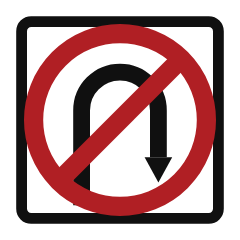
5. A driver who wants to reverse direction arrives at this sign. What is allowed?
Show answer
Answer C: Going on and reversing direction only where the maneuver is permitted
The restriction removes that maneuver at that spot entirely, so the driver has to continue and turn the vehicle around at a place where it is not prohibited.
-
6. Outside a school zone or highway construction zone, how does Louisiana classify a hands-free law violation?
Show answer
Answer C: As a secondary offense with a fine of 100 dollars
Away from those zones the violation is secondary, meaning the officer must have detained the driver for another offense, and the fine is 100 dollars.
-
7. A driver who is passing you cannot complete the pass because a vehicle is coming. What should you do?
Show answer
Answer C: Ease off the accelerator and make room for them to drop back in
The only place for the passing vehicle to go is the gap behind you, and easing off opens that gap immediately.
-
8. A truck passes you in heavy rain and its spray blanks out your windshield. What should you do?
Show answer
Answer B: Hold the wheel steady, ease off slightly and let the wipers clear it
The blackout lasts a second or two. Keeping your line and easing off is far safer than braking hard or steering blind toward the shoulder.
-
9. An exit ramp is separated from the highway by a triangle of pavement painted with white stripes. What may you do there?
Show answer
Answer C: Nothing; keep off it and choose either the lane or the ramp
The striped area between a ramp and the through lanes is not for driving, stopping or last-second changes of direction.
-
10. How can you tell a tire has reached its wear limit without measuring it?
Show answer
Answer C: The wear bars across the grooves become level with the tread
Molded bars sit at the bottom of the grooves. Once the surrounding tread has worn down to them, the tire has reached the end of its safe life.
-
11. You realize your tires are running on ice. Which set of inputs is safest?
Show answer
Answer C: Gentle steering, no sudden braking, and no sudden acceleration
Whatever grip is left is used up at once by any sudden input, so every movement of wheel, brake and accelerator must be slow and small.
-
12. You have signaled and pulled up level with the car in front of an empty curb space. What comes next?
Show answer
Answer A: Reverse slowly while turning the wheel toward the curb
From alongside the forward car you back in on a turn toward the curb, then straighten and swing the front in as the rear reaches the space.
-
13. A bicyclist stops at a four-way stop just before you do. Who goes first?
Show answer
Answer B: The bicyclist, who reached the intersection and stopped there before you did
A bicyclist on the roadway follows the same right of way rules as a driver, so arrival order decides the turn.
-
14. Why should your thumbs rest along the rim rather than hook inside the spokes?
Show answer
Answer D: A jolt can spin the wheel and injure hooked thumbs
A pothole or a dropped wheel can snap the wheel round violently, and thumbs hooked through the spokes are trapped when it happens.
-
15. Until what age does Louisiana normally keep a child in a belt-positioning booster seat?
Show answer
Answer D: Until the child turns nine
A Louisiana child moves from a booster to the vehicle safety belt at that age, or earlier only where the child has outgrown the booster's height or weight limits and the belt fits properly.
-
16. How does eating a large meal before drinking affect impairment?
Show answer
Answer D: It slows absorption but the alcohol still reaches the blood and impairs you
Food delays how quickly alcohol enters the bloodstream, which can make the peak arrive later, but all of the alcohol is eventually absorbed.
-
17. A diamond-shaped sign is used to
Show answer
Answer A: warn of a condition on or next to the road that may call for caution
The diamond is the standard shape of the warning series, which alerts drivers to conditions that would otherwise not be obvious in time to react.
-
18. Rain is heavy enough that you have your windshield wipers running. What else should you switch on?
Show answer
Answer A: Your headlights, so you can see and others can see you
Rain heavy enough to need wipers also cuts how far away you can be seen, so the headlights belong on. Many states write this into law as a wipers on, lights on rule.
-
19. You pull onto a soft grass verge to park. What is the main risk?
Show answer
Answer A: The wheels can sink and the car can slide toward the ditch
Soft ground gives way under the weight of a vehicle, and a car that settles or slides sideways can end up stuck or in the ditch.
-
20. You are driving along a street lined with parked cars. What should you watch for?
Show answer
Answer B: Doors opening, vehicles pulling out and pedestrians stepping from between cars
Parked cars hide people and can move without warning. Keep as much space from them as you safely can and cover the brake.
-
21. You are overtaking in a short passing lane on a two-lane road and it is about to end. What must you do?
Show answer
Answer A: Finish the pass and move back to the right before it ends
The added lane ends and the traffic returns to a single lane in each direction, so the pass has to be complete before the pavement runs out.
-
22. On an overhead guide sign, the small exit number panel sits above the left-hand end rather than the right. What does that placement tell you?
Show answer
Answer A: The exit leaves from the left side of the roadway
The exit number plaque is placed on the side from which the ramp leaves, which gives advance notice of the unusual left-hand exit.
-
23. Two solid yellow lines are painted down the center of a two-way road. What do they mean?
Show answer
Answer B: Traffic in neither direction may cross them to pass
A double solid yellow line marks a no-passing zone that applies to traffic traveling in either direction.
-
24. A sign on a long downgrade points to a runaway vehicle ramp. What is that ramp for?
Show answer
Answer C: Trucks that have lost braking ability on the grade
A runaway ramp is an escape lane of loose material that stops a heavy vehicle whose brakes have overheated or failed, so it must always be left clear.
-
25. You are at a red light where right turns on red are allowed, you cannot see clearly, and the driver behind sounds the horn. What should you do?
Show answer
Answer C: Stay stopped until you can see that the turn is safe
Turning right on red is permitted, never required, so you wait until you can see that the way is clear no matter what the driver behind does.
-
26. What is the basic rule for entering a roundabout?
Show answer
Answer B: Traffic already circulating goes first, and you wait for a gap
Entering traffic yields to vehicles already going around the circle, which is what keeps a roundabout moving instead of locking up.
-
27. You reach an uncontrolled intersection at the same moment as a vehicle approaching from your left. What should you do?
Show answer
Answer A: Proceed, but only once you see that driver slowing
You have the right of way over the vehicle on your left, but a right of way is something the other driver has to give, so confirm it before you commit.
-
28. Why are pedestrians and cyclists a special risk on unlit streets at night?
Show answer
Answer A: Dark clothing can make them invisible until they are very close
A person in dark clothing reflects almost no light and may not appear until they are inside your stopping distance, so cut your speed where people may be about.
-
29. A sign reads MINIMUM SPEED 40. What does it require of a driver?
Show answer
Answer C: Not to drive below that speed when conditions allow
A minimum speed limit keeps unnecessarily slow vehicles from obstructing traffic, but it never overrides the duty to slow down for weather or congestion.
-
30. Where is the no passing zone pennant sign installed?
Show answer
Answer A: On the left side of the roadway
The pennant is placed on the left side of the roadway at the beginning of the no-passing zone, in the field of view of a driver who is thinking about overtaking.
-
31. What do zero tolerance laws mean for a driver who is under 21?
Show answer
Answer B: They commit a violation at an alcohol level far below the adult limit
Drivers under 21 may not legally drink, so every state sets a limit far below the adult one and treats even a trace reading as a violation. The exact figure is set by each state, and the penalty usually includes losing the license.
-
32. How long must a Louisiana driver keep an SR-22 filing on record after a conviction that requires proof of future financial responsibility?
Show answer
Answer A: Three years from the date of conviction
Louisiana requires the SR-22 certificate to be maintained for three years from the conviction date, with a cash or security deposit of 30,000 dollars as the alternative.
-
33. A barricade carries a sign reading ROAD CLOSED TO THROUGH TRAFFIC. What does it permit?
Show answer
Answer B: Local access for people whose destination is on that road
This closure keeps out drivers who are only passing through while still allowing residents and deliveries to reach addresses within the closed section.
-
34. You have a small extinguisher and a fire has started under the hood. What is the safe way to use it?
Show answer
Answer B: Release the latch and spray through the gap without raising the hood at all
Opening the hood feeds the fire a rush of air, so spraying through the gap at the base of the flames is both safer and more effective.
-
35. You see an open curb space on the opposite side of a two-way street. What should you do?
Show answer
Answer B: Drive on, turn around, and come back on that side
You must park on the right, facing the direction of travel, so reaching a space on the other side means going around rather than crossing into it.
-
36. You arrive at an intersection with no signs, no signals and no markings at the same time as a vehicle on the road to your right. What must you do?
Show answer
Answer B: Yield to the vehicle on your right
At an uncontrolled intersection you must yield to a vehicle already in the intersection or approaching from your right.
-
37. A short driver cannot get ten inches between the chest and the steering wheel airbag. What is the answer?
Show answer
Answer D: Move the seat back and tilt the wheel downward, or fit pedal extenders
Distance from the airbag is gained by moving the seat back and aiming the wheel at the chest, using pedal extenders if the pedals are then out of reach.
-
38. What does Louisiana law forbid a parent or guardian from doing?
Show answer
Answer D: Knowingly permitting an unlicensed child under seventeen to drive on a public road
Louisiana makes it unlawful for a parent or guardian to cause or knowingly permit a child or ward under 17 to drive on a public road unless the child is licensed to do so.
-
39. Two left-turn lanes are available and you must turn right again a short distance after the turn. Which of the two should you use?
Show answer
Answer D: The right one, so you finish nearer the right side of the new street
Each turn lane feeds the matching lane of the new street, so choosing the right-hand of the two left-turn lanes leaves you closer to the side you will need.
-
40. A driver is following you far too closely and you have a turn coming up. How should you slow down for it?
Show answer
Answer B: Signal early and slow gradually well before the turn
Early signals and gentle braking give a tailgater the time and distance they have failed to leave for themselves.