
Louisiana OMV Permit Practice Test 18
- Questions40
- Correct to pass32
- Passing score80%
- Minimum age15 years
-
1. What is the minimum light transmission Louisiana allows through the front side windows of a car?
Show answer
Answer C: Twenty-five percent
Louisiana requires at least 25 percent light transmission through the windshield strip and the front side windows, while the rearmost windows may go down to 12 percent.
-
2. You are stopped at a stop sign waiting to turn onto a highway where traffic moves at 55 mph. How should you choose your gap?
Show answer
Answer A: Wait for a much larger gap than the one you would accept on a city street
Fast traffic covers ground while you are still accelerating, so the gap that feels adequate at 25 mph is dangerously short at highway speed.
-
3. At highway speed, a large object suddenly appears in your lane and there is open space beside you. Which response is often the most effective?
Show answer
Answer B: Steer around it, since at speed you can often turn quicker than you can stop
Above roughly 25 mph, stopping distance is long while a lane change takes only a moment. When space is available, a controlled steer around the hazard avoids the impact.
-
4. You want to turn right at a steady red light and no sign prohibits the turn. What is required?
Show answer
Answer B: Come to a complete stop, then yield to traffic and pedestrians before turning
A right turn on a steady red is permitted only after a complete stop and only after yielding to cross traffic and to pedestrians, and a posted sign can prohibit it entirely.
-
5. What are front fog lights for?
Show answer
Answer D: Adding a low, wide beam close to the car when visibility is poor
Fog lights throw a low, wide beam under the fog, which is why they are mounted low and are used only in poor visibility.
-
6. What is the safest way to pass a bicyclist on a road with two lanes going your way?
Show answer
Answer D: Change lanes completely, as you would for a car
A bicycle is entitled to the room a vehicle needs, and moving into the next lane gives the rider space to swerve around a drain or a pothole.
-
7. In a work zone, the flagger's instructions conflict with the pavement markings still visible on the road. Which do you follow?
Show answer
Answer B: The flagger, because a person directing traffic outranks the markings
An authorized flagger controlling a temporary traffic control zone overrides signs, signals and markings, and drivers must obey the flagger's signals.
-
8. Why is a shoulder check especially important on a road with motorcycles and bicycles?
Show answer
Answer D: A narrow vehicle can disappear completely in the blind spot
A motorcycle or a bicycle is small enough to be hidden entirely by a door pillar or by the blind spot the mirrors do not cover.
-
9. A sign reads END SCHOOL ZONE. What does it tell a driver?
Show answer
Answer A: The regular limit for that road applies again
An end of restriction sign marks the downstream limit of a special zone, after which the ordinary speed limit for that road governs again.
-
10. What does Louisiana law say about local automated speed enforcement cameras on interstate highways?
Show answer
Answer C: Local authorities may not install or use them to regulate interstate traffic
Louisiana forbids municipal and parish authorities from installing or using automated speed enforcement devices to regulate traffic on interstate roadways within their limits.
-
11. Why is standing water across a road dangerous even when it looks shallow?
Show answer
Answer B: It can hide a washed out roadbed, a deep hole or a missing cover
You cannot see the surface under the water, and floods commonly wash the roadbed away or lift covers off drains.
-
12. Your vehicle stalls on a railroad crossing and will not restart. What should you do first?
Show answer
Answer A: Get everyone out and away from the tracks immediately
Everyone must leave the vehicle and move well clear of the tracks at once, walking toward the train at an angle so that debris from an impact travels away from you.
-
13. Is it a good idea to shift into neutral and coast down a long hill to save fuel?
Show answer
Answer B: No, you lose engine braking and some control of the vehicle
In neutral the engine cannot help slow the vehicle, so the brakes do all the work and can overheat. Stay in gear so the drivetrain helps hold your speed.
-
14. You have a green light and are turning right while people are crossing the street you want to enter. Who goes first?
Show answer
Answer B: The pedestrians, and you wait until they are clear of your path
A green light permits the turn but does not remove the duty to yield to pedestrians already crossing the street you are turning into.
-
15. When should you adjust your seat, mirrors and steering wheel?
Show answer
Answer B: Before you start moving
Adjusting the driving position while moving takes your attention and often your hands away from driving. Make every adjustment while parked, every time.
-
16. You carry reflective warning triangles in your car. How should they be used after a breakdown?
Show answer
Answer B: Set out behind the vehicle, far enough back to warn traffic before it arrives
A warning device works only if drivers see it in time to react, so it is placed well back along the road they are traveling.
-
17. A school crossing guard has returned to the curb but two children are still walking across the road. When may you go?
Show answer
Answer C: Only after the children have reached the far sidewalk
The guard leaving the road does not end your duty; you stay stopped until every child is clear of the roadway.
-
18. You have stopped on the shoulder of a busy freeway with a flat tire that you cannot change safely. Where should you and your passengers wait?
Show answer
Answer A: Well away from the traffic side, behind a barrier or up the bank if there is one
People struck on the shoulder are a common cause of roadside deaths, so wait away from the traffic side and behind any barrier.
-
19. A bus stopped at the corner hides the crosswalk you are about to turn across. What should you do?
Show answer
Answer C: Turn slowly, ready to stop for anyone stepping out in front of it
People often step into the road from in front of a stopped bus, so approach the hidden crosswalk slowly and be ready to stop.
-
20. Why is a sign reading BRIDGE ICES BEFORE ROAD worth heeding even when the road itself is merely wet?
Show answer
Answer C: Cold air passes under a bridge as well as over it
A bridge deck loses heat from below as well as above, so it can be frozen while the road on either side of it is only wet.
-
21. How should the outside mirrors be aimed to reduce your blind spots?
Show answer
Answer A: Outward, so each one covers the lane beside you rather than repeating the inside mirror
Mirrors aimed too far inward show you the same road three times and leave a large gap beside the vehicle, so aiming them outward shrinks the blind spot.
-
22. You are driving through patchy fog on a highway. What should you be ready for?
Show answer
Answer B: Sudden dense banks where visibility drops within a few car lengths
Patchy fog can go from clear to nearly blind in a moment, so keep your speed low enough that a sudden bank does not leave you without room.
-
23. Is it acceptable to drive with your vehicle straddling the line between two lanes?
Show answer
Answer D: No, you must drive as nearly as practical entirely within a single lane
A vehicle astride the line takes up two lanes and leaves the drivers around it unable to predict where it will go.
-
24. In a work zone the temporary lane lines conflict with the old lines still visible on the pavement. Which do you follow?
Show answer
Answer C: The temporary markings, which show the current traffic pattern
Temporary markings define the traffic pattern in force, and the old lines are simply the layout that no longer applies.
-
25. Which sequence describes a well-made turn?
Show answer
Answer A: Signal, move into the correct lane, slow down, check, then turn
Tell others first, take your position, lose the speed before the corner, take a final look, and only then steer through the turn.
-
26. The only person offering you a ride home has been drinking. What should you do?
Show answer
Answer B: Do not get in; find another way home
A passenger in an impaired driver's vehicle shares all of the risk and can do nothing about it from the seat, so the only safe answer is another ride.
-
27. How much following distance should you keep behind a motorcycle?
Show answer
Answer C: At least three to four seconds
A motorcycle can slow or stop very quickly and is easily upset by a surprise, so allow three to four seconds instead of the usual car gap.
-
28. At 45 mph you look at a navigation screen for four seconds. Roughly how far do you travel unseeing?
Show answer
Answer D: About 260 feet
At 45 mph you cover roughly 66 feet a second, so four seconds on a screen is around 260 feet of road that you never looked at.
-
29. Lights set into the pavement along both edges of a crosswalk start to flash yellow as you approach. What do they tell you?
Show answer
Answer D: Someone is crossing and has to be given way
In-roadway warning lights flash only when a pedestrian activates the crossing, so a flashing pattern means somebody is in or entering the crosswalk.
-
30. In plain words, what is oversteer?
Show answer
Answer C: The rear of the vehicle slides out and the car turns too sharply
Oversteer means the rear tires have lost grip first, so the tail swings out and the vehicle turns more than you asked it to.
-
31. You have printed directions or paperwork you need to check. When should you read them?
Show answer
Answer C: Before you leave, or after you park
Reading takes eyes and mind off the road for far longer than any safe glance, and a light that changes while you read leaves you moving off blind.
-
32. You are parking on a hill where there is no curb, whether facing up or down. Which way should the front wheels point?
Show answer
Answer B: Toward the shoulder, so the vehicle would roll away from the traffic lanes
With no curb to stop the vehicle, the wheels are turned toward the edge of the road so that a runaway vehicle leaves the roadway instead of entering it.
-
33. A sign with a yellow background and a black legend generally conveys
Show answer
Answer B: a general warning
Yellow is the background color used for general warning signs, so a yellow sign tells the driver to expect something ahead rather than to obey a rule.
-
34. An officer directing traffic faces you and holds one hand up with the open palm toward your vehicle. What does the gesture mean?
Show answer
Answer D: Stop before reaching the officer
A raised open palm shown toward a driver is the standard signal to stop.
-
35. You are turning left at an intersection and an oncoming bicyclist is approaching in the bike lane. What must you do?
Show answer
Answer B: Yield and complete the turn only after the bicyclist has passed
A bicycle in the roadway has the same right of way as a vehicle, so a left-turning driver must yield to an oncoming rider just as to an oncoming car.
-
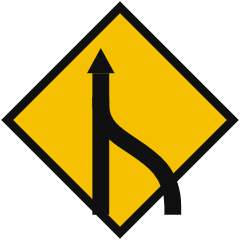
36. What does this sign warn a driver about?
Show answer
Answer A: Traffic from another roadway will enter the same lane ahead
Two traffic streams come together into one lane beyond this point, so drivers on both roadways have to adjust speed and spacing to fit together.
-
37. What does it mean to cover the brake, and when should you do it?
Show answer
Answer B: Hold your foot over the brake pedal without pressing it when a hazard seems likely
Covering the brake cuts reaction time when you expect trouble, such as near children, parked cars or a vehicle that may pull out. Riding the brake wears it out and confuses drivers behind you.
-
38. In which situation does Louisiana law forbid a driver from refusing a chemical test altogether?
Show answer
Answer D: Whenever a fatality has occurred or a person has sustained serious bodily injury
Louisiana removes the option of refusal where the incident caused a death or serious bodily injury, and also where the driver has already refused on two previous and separate occasions.
-
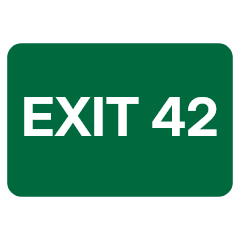
39. Where is signing of this kind normally placed along a freeway?
Show answer
Answer D: Ahead of the interchange and again at the exit, so a driver can reach the correct lane in time
Guide information for an interchange is repeated on the approach and at the ramp, because a driver who learns about the exit only at the last moment has no room left for a safe lane change.
-
40. You are circulating in a roundabout and a vehicle is waiting to enter ahead of you. What should you do?
Show answer
Answer D: Keep going, because circulating traffic does not stop for entering vehicles
Stopping in the circle to be polite surprises the drivers behind you and defeats the design; entering traffic is the side that waits.